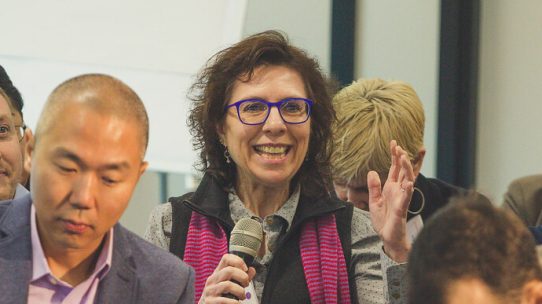
What does social innovation mean to you in the current context today?
In the Shipyard Foundation, we have been dealing with social innovations for many years, and the issue of definition remains a central challenge. The point is not to arrive at a single, orthodox definition. I think it must keep up with the situation and change as the innovations themselves do.
The current context prompts us to look at innovation differently because the context itself is undergoing radical change. Previously, challenges and available solutions remained in some kind of “equilibrium”, but with the changing circumstances and the emergence of new, previously absent threats, innovation should serve as a method of keeping up with them — sometimes overtaking them, sometimes preventing them. Extreme and sudden situations require quick reactions, innovation, the ability to improvise, and to break down complex problems into smaller parts. This is an important skill.
In this sense, being innovative — having the capacity to innovate — is no longer an additional attribute. It has become a key, almost existential ability, something like a life skill that you need to survive, adapt, or deal with a situation. In a world where everything is connected to everything else and the scale of problems overwhelms us, we need to look for solutions that have a human scale. What else is left for us? We can’t just curl up and hide, even though sometimes we want to. We need to plan actions and prepare for different scenarios.
Challenges usually trigger three possible types of reactions — fight, flight, and freeze. The first, broadly understood as fighting and dealing with problems, requires innovation. Extreme situations, including those caused by humans — such as wars — have always been one of the fundamental catalysts for innovation. It is the fight that requires thinking. Escape or freezing is a form of abdication or abandonment; they don’t require much innovation.
A good example of society’s ability to innovate for survival is the extraordinary achievements of Ukrainian society. We are not talking only about innovations in the military field, although these are of great importance, but also about shaping social resilience — coping in situations of extreme danger, in everyday matters of survival, energy, food, education, care, and many others.
Of course, besides micro-innovations, which we deal with, some fundamental macro-innovations are needed. Their deficit might have led to the situation we are in now. We have been satisfied with small, not radical enough changes. After the economic crisis, epidemics, and now wars — and with democratic systems that paradoxically undermine themselves — we see this clearly.
A good example is the problem of democratic governance in its current form, which too often relies on managing fear, resentment, hatred, and manipulation. Democracies can indeed commit suicide. We need new models — more deliberative, less arithmetic — that are resistant to demagoguery, seduction, and bribery.
In the world we live in, where technology has far exceeded our expectations and where our “muscles” are more developed than our judgment and conscience, we must ask ourselves serious questions, which are important for the search for innovations. The essence of these are not only “know-how” — how to do things — but also “know-why”: why we do them, and whether we should do them at all.
This kind of prudent reflection, which is quite distinct from knowledge and so-called intelligence, remains a human capacity — even though many would prefer to delegate it to machines. Technologies can replace us in many areas, but some territory must remain exclusively and uniquely human. The mere fact that we can do things more efficiently and cheaply does not mean we should. A good example may be the issue of care. We must protect what is organic, human, even if it is flawed.
Mary Shelley’s Frankenstein is instructive here. The Monster tells Dr. Frankenstein: “You are my creator, but I am your master. Obey.” This is an important warning.
What can social innovation offer at this moment?
Poland has very deep and long roots in social self-organisation. It has traditions from which it can draw, but they need to be re-enacted anew. To a large extent, they are spontaneous and insurrectionary in nature. There is much bottom-up improvisation. In Poland, we are a bit anarchistic; better at circumventing and disarming the system than at building it.
Still, we have a fairly extensive network of social innovation support — incubators, funds for prototyping — much of it due to European funds. But these will eventually run out, so we need to build a system able to cope without them, based on national resources. This doesn’t mean avoiding external cooperation — on the contrary, we should continue generous exchange and collaboration. Current activities in transnational consortia can help make that happen.
We can create prototypes in Poland quite quickly and test them efficiently. Scaling up, however, remains a challenge. We need projects that sit somewhere between the micro and the macro — something like mezzo-projects. Without that, many prototypes remain parked, like “concept cars”. We are trying to change that. More often now, our innovation work focuses on specific, emerging challenges — for example, the epidemic of loneliness or innovations needed in border situations.
We also look at what can grow from existing resources. For example, what social actions or innovations could build on Poland’s dense network of parishes — about 11,000 of them? In a country where secularization is progressing faster than anywhere else in Europe, we are exploring what new roles parishes can play for communities.
Our current work also looks at resilience — not only individual, but collective resilience — “social monads”, grounded in local communities where concern for something more than individual well-being or survival emerges. It’s a turn toward more decentralised, communitarian models of community-building. We try to analyse how such organisms respond to threats and where they derive their resilience. One thing is certain: To achieve it, cooperation between state and local institutions, business, social organisations, and ordinary citizens is essential.
Where do you find energy? Where do you find hope?
These are good questions — and connected. In a way, energy comes from the hope that we are looking for. There is a lot of deeper reflection in Poland about the meaning of action. The term post-activism has appeared — not as a call to give up action, but to reflect on them. It’s an escape from spontaneous, chaotic, and often unproductive action.
There is discussion on the form and mode of contemplation among people involved in activism. They search within themselves and outside for deeper roots and perspectives of their actions. Contemplation is often treated as opposition to action. There is a lot of truth in this, but here it is not so much about action, but rather about re-action, that is, acting in response to something. This necessarily requires reflection on the causes and precision in determining the directions of action.
We are also looking for sources of clean energy — organic, internal energy. In Poland, there is no shortage of funds (thanks to European funds) for building prototypes and social innovations, but these funds will run out. We must learn to maintain this system with local resources. This does not diminish the role of international cooperation and the exchange of ideas. We value this very much. The spirit of cooperation that has always been part of SIX will live on.
Speaking of energy, it is stimulated by one of the strongest emotions — the need for security. Over the past 30 years, some of us believed, as Fukuyama wrote, that “History had ended.” It turns out it hasn’t. It has not ended and it wants to repeat itself. For Poland, that brings the worst associations. So, although it is not always the best motivation (often focused on self-protection), it is certainly an important motivation for seeking innovation. In an unpredictable world, the ability to build new solutions, transform, permute, and morph people and institutions can be of great importance.
What is your message to the world right now?
We now live in a world where emotions compete — between independence and interdependence. Both matter, and we must find the right balance. Everything is connected: the threats, but also the solutions. Almost all social challenges — democratic deficits, epidemics, migration, war, polarisation and radicalisation, loneliness, dependence on technology — appear everywhere. This means that we are looking for solutions everywhere around the globe and can borrow them.
The role of institutions like SIX is especially important because they bring access to experiences from outside the European Union, which are valuable, often precisely because they were created in different contexts and sometimes propose completely radical solutions. They are significant as many of the experiences were created in scarcity, not surplus, which makes them more authentic and sustainable.
In the world we live in, global cooperation and exchange are not luxuries — they are necessities. Good luck, SIX.